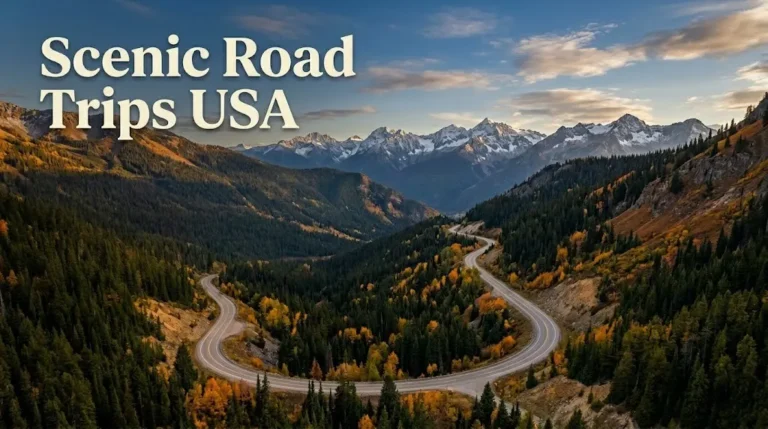
The best road trips in the USA reward travelers who plan ahead, pick the right season, and book campgrounds months before departure. This guide names specific routes, specific overnight stops, and specific campgrounds so you can make real decisions today.
The National Park Service reports that more than 325 million people visited national parks in a recent year. Most of the iconic road trip routes in this country pass directly through NPS-managed land.
This article covers 8 named routes, where to sleep along each one, which months to go, and what most first-time road trippers get wrong before they leave home.
Road Trips in the USA: What Makes a Route Worth Your Time
A road trip in the USA earns its place on any list by delivering a genuine payoff at the destination, not just good photos on the highway.
The best routes combine scenic driving with real stopping points: named parks, named towns, and named campgrounds where you can sleep inside the experience.
Routes that are only highways without overnight options force you into motels in forgettable towns. A great route has campground access within 30 minutes of the key stops.

First-time road trippers often confuse a pretty drive with a complete road trip. A complete route has a beginning, a middle, and a reason to stop.
The honest limitation of every road trip in the USA is this: the route is only as good as the plan behind it. Poor campground booking, wrong season, or the wrong vehicle can ruin any route.
| Factor | Why It Matters |
|---|---|
| Named campground stops | Determines where you sleep and how much you spend |
| Season of travel | Affects road access, crowds, and permit requirements |
| Vehicle type | Some routes are closed or dangerous for RVs |
| Booking lead time | NPS campgrounds fill 6 months out in summer |
| Route direction | Some drives are dramatically better one direction |
Insider Tip:
Drive iconic routes during shoulder season: May through June or September through October. Campground availability opens up and crowds thin by 40 to 60 percent compared to July.
For RV travelers, check vehicle length restrictions before committing to any mountain route. Going-to-the-Sun Road and several Utah canyon roads have hard limits.
Always verify current road conditions through the NPS or relevant state DOT before departure. Road closures change with weather events, fire damage, and seasonal snowpack.
Best Road Trips in the USA: Our 8 Top Routes Ranked
The 8 best road trips in the USA are the Pacific Coast Highway, Route 66, Blue Ridge Parkway, Going-to-the-Sun Road, Beartooth Highway, Utah Scenic Byway 12, the Florida Keys Overseas Highway, and the Olympic Peninsula Loop.
Each route was selected based on scenic payoff per driving mile, quality of overnight camping options, honest accessibility by traveler type, and seasonal viability.
| Route | Total Distance | Realistic Days | Best Season | RV Suitable | Honest Note |
|---|---|---|---|---|---|
| Pacific Coast Highway | 656 miles | 5 to 7 days | April to June | Mostly yes, check Big Sur sections | Campgrounds fill 6 months out in summer |
| Route 66 | 2,278 miles | 10 to 14 days | April to May, Sept to Oct | Yes | Best sections are Missouri and New Mexico; stretches of Oklahoma feel hollow |
| Blue Ridge Parkway | 469 miles | 4 to 6 days | Oct for foliage, May to June | Yes, but no hookups at NPS campgrounds | Speed limit is 45 mph throughout; plan accordingly |
| Going-to-the-Sun Road | 50 miles | 1 to 2 days as part of longer Glacier trip | Mid-July to mid-September | No for vehicles over 21 ft between Avalanche and Sun Point | Vehicle reservations required in peak season; verify current system annually |
| Beartooth Highway | 68 miles | 1 day drive, 2 to 3 for area | July to mid-September | Yes for most RVs, caution on switchbacks | Passes close by early October with first heavy snow |
| Utah Scenic Byway 12 | 124 miles | 2 to 3 days | May to June, Sept to Oct | Yes, but some pullouts are tight | One of the most geologically varied roads in the US |
| Florida Keys Overseas Highway | 113 miles | 2 to 3 days | November to April | Yes | Summer heat and humidity are extreme; hurricane season July through November |
| Olympic Peninsula Loop | 330 miles | 4 to 5 days | June through September | Yes, check campground size limits | Hoh Rain Forest requires separate campground reservation |
Experienced road trippers know that Byway 12 in Utah often delivers more per mile than the more famous PCH. It is less crowded and more geologically dramatic.
According to the National Park Service, peak visitation on most of these routes runs from June through August. Arriving in September drops your competition for campsites significantly.
Best Road Trips Out West: Desert, Coast, and Mountain Routes
The best road trips out west divide into three distinct environments: Pacific Coast, Rocky Mountain, and the Colorado Plateau desert system.
Each environment demands different planning. Desert routes require heat management. Mountain routes require snow window awareness. Coast routes require campground reservations far in advance.
Pacific Coast travelers should know that Highway 1 through Big Sur closes periodically after storm damage. Always check the Caltrans road conditions page before committing to a Big Sur campground reservation.
The Colorado Plateau routes, including Byway 12 through Grand Staircase-Escalante and Capitol Reef, offer some of the most remote and uncrowded driving in the country.
Budget travelers benefit most from western BLM land. Dispersed camping near Moab, Utah, along the Colorado River corridor is free with no permit required in many areas. Verify current access with the BLM Moab Field Office before your trip.
Rocky Mountain routes like Beartooth Highway and Going-to-the-Sun Road have narrow weather windows. Both are typically closed from October through May.
The US Forest Service reports that dispersed camping on national forest land adjacent to many western routes is permitted without a fee in most cases. Check the specific forest’s travel management plan before camping.
RV travelers should note that the most scenic western mountain roads often have the strictest vehicle size limits. The eastern and southern road trip routes generally offer better hookup infrastructure.
Insider Tip:
Book Watchman Campground at Zion National Park through Recreation.gov the moment the 6-month booking window opens. Electric hookup sites sell out within hours. Tent sites last a day or two longer.
National Park Road Trips: Planning Your Multi-Park Route
A national park road trip in the USA works best when you route between parks that are within 3 to 5 hours of each other. Driving 10 hours between parks every day is not a road trip; it is a commute.
The most efficient multi-park routes in the country are the Utah Five Parks Loop (Zion, Bryce Canyon, Capitol Reef, Canyonlands, Arches), the Northern Rockies Loop (Yellowstone, Grand Teton, Glacier), and the Pacific Northwest Loop (Olympic, Rainier, Crater Lake).
The America the Beautiful Interagency Annual Pass covers entrance fees at all three multi-park routes. For a traveler hitting 3 or more national parks in a trip, the pass pays for itself quickly. Verify current pass pricing directly with the NPS before purchase.
Key Takeaway: Buy the America the Beautiful Pass before any multi-park road trip; it pays for itself at the third park entrance.
Reservation logistics for multi-park trips require staggered booking. Each park campground opens its 6-month booking window on a different date.
To book a multi-park route correctly:
- List every NPS campground you plan to use and its booking platform (primarily Recreation.gov).
- Find the specific date each campground’s 6-month window opens (varies by campground, not by park).
- Set calendar alerts for each opening date. Be on Recreation.gov exactly at 10am Eastern when windows open.
- Book campgrounds in order of scarcity: Watchman at Zion, Fruita at Capitol Reef, and Apgar at Glacier fill fastest.
- Build 1 to 2 flex nights into your itinerary for campgrounds where you’ll use walk-in or first-come sites as backup.
Fruita Campground at Capitol Reef National Park has 71 sites and sits directly among the orchards the park is named for. It books through Recreation.gov and fills fast for spring and fall.
Families with children should prioritize campgrounds with flush toilets and paved site pads. Fruita and Watchman both have flush toilet facilities. Some backcountry-adjacent campgrounds in these parks use vault toilets only.
Pacific Coast Highway Road Trip: San Francisco to Los Angeles
The Pacific Coast Highway from San Francisco to Los Angeles covers roughly 400 to 650 miles depending on how much of Highway 1 you drive versus US-101. Realistic drive time with stops is 5 to 7 days.
Drive it south from San Francisco. The cliffs drop to your left with ocean views the entire way, which is more dramatic than driving north with the cliff wall on your side.
Kirk Creek Campground on the Big Sur coast is the best overnight stop on this route. It sits on a bluff directly above the Pacific and is managed by the Los Padres National Forest through Recreation.gov.
Kirk Creek has 33 sites for tents and self-contained vehicles. It has no hookups and no showers. Most sites sell out 6 months in advance for summer weekends.
Couples find Kirk Creek delivers the dramatic ocean camping experience the photos promise. Sites 1 through 15 have the most direct cliff-edge exposure.
RV travelers should know Kirk Creek has a maximum RV length of 30 feet. The access road on Highway 1 through Big Sur has tight curves unsuitable for longer rigs.
Important Safety and Conditions Notes for the Pacific Coast Highway:
Highway 1 through Big Sur has experienced significant storm and landslide damage in recent years. Sections have closed for months at a time without advance notice.
Verify the following before your trip:
- Current Highway 1 road status through the Caltrans QuickMap tool before booking any Big Sur campground
- Kirk Creek Campground availability and access road conditions through the Los Padres National Forest ranger station
- Any active fire restrictions in the Los Padres National Forest through the USFS fire restrictions map
- Whether your vehicle length is within the stated limit for Highway 1 pullouts and campground access roads
Always check conditions the day before departure, not just at the time of booking.
Route 66 Road Trip: Chicago to Santa Monica
Route 66 from Chicago to Santa Monica, California covers 2,278 miles of historic highway across 8 states. A realistic drive with meaningful stops takes 10 to 14 days.
Drive it west from Chicago. You gain time zones as you go, which gives you more daylight at the end of each day in the western desert sections.
The most honest assessment of Route 66 is that it is uneven. Some states deliver genuine historic character. Others have stretches of abandoned highway with little to see.
The best states on Route 66 are New Mexico and Arizona. The worst for actual content are parts of Texas and eastern Oklahoma, which are largely flat highway with limited stops.
Named stops worth time:
- Cadillac Ranch near Amarillo, Texas: Ten Cadillacs buried nose-first in a field. Genuinely strange. Free to visit. Worth 30 minutes.
- Petrified Forest National Park, Arizona: Off Route 66 but within 5 minutes of the alignment. The painted desert views are worth a half day.
- Wigwam Motel in Holbrook, Arizona: Iconic accommodation stop. Book ahead; it fills in peak season.
- Santa Monica Pier: The official western terminus. Worth the photo and the walk, then get off the pier.
- Williams, Arizona: The best base town for Route 66 travelers also visiting the Grand Canyon’s South Rim.
Mather Campground at Grand Canyon South Rim is 1 hour from Williams and books through Recreation.gov. It has 327 sites including tent-only and electric hookup options.
First-time road trippers often spend too long in Missouri and Kansas. The western two-thirds of the route deliver more per mile.
Blue Ridge Parkway Road Trip: Virginia to North Carolina
The Blue Ridge Parkway runs 469 miles from Shenandoah National Park in Virginia to Great Smoky Mountains National Park in North Carolina. The entire road is managed by the National Park Service.
Drive it south from the Virginia end if you want to finish in Asheville, North Carolina, which has the best food, lodging, and services at the route’s southern end.
The speed limit on the Blue Ridge Parkway is 45 miles per hour for the entire length. Google Maps’ 9-hour estimate for the full drive is only accurate if you make zero stops.
Plan for 4 to 6 days. The Parkway has genuine fog, steep drop-offs, and no guardrails on significant sections. Drive it in daylight.
NPS campgrounds along the Parkway include Peaks of Otter, Roanoke Mountain, Rocky Knob, Doughton Park, Julian Price, Linville Falls, and Mount Pisgah. All book through Recreation.gov.
Julian Price Campground near Blowing Rock, North Carolina has 198 sites. It sits at 3,400 feet elevation in a hardwood forest. It is the largest campground on the Parkway.
Couples should target sites in the loop B section of Julian Price. They are more private and farther from the main road noise.
Families with children should note that most Parkway campgrounds have vault toilets, not flush facilities. Julian Price and Peaks of Otter have flush toilets. Plan accordingly.
Key Takeaway: On the Blue Ridge Parkway, plan for half the daily mileage you would on an interstate; the 45 mph limit and fog sections make 150 miles a full day.
The honest limitation of the Parkway is that October weekend campground availability is essentially zero without a reservation made months in advance. Fall foliage season packs every site.
According to the National Park Service, the Blue Ridge Parkway receives approximately 15 million visits annually. It is one of the most visited units in the NPS system.
Going-to-the-Sun Road Trip: Glacier’s Most Iconic Drive
Going-to-the-Sun Road crosses Glacier National Park in Montana over a 50-mile stretch from West Glacier to St. Mary. It climbs over Logan Pass at 6,646 feet elevation.
It is not a standalone road trip. It is the centerpiece drive of a larger Glacier National Park experience, ideally combined with 3 to 5 days of hiking and camping in the park.
The road is typically open from mid-June through mid-October. Snow can delay opening into July in heavy winters.
In peak season, the National Park Service requires timed-entry vehicle reservations to drive the road between Avalanche Creek and the Sun Point parking area. Verify the current reservation system and dates directly with Glacier National Park before planning your trip. This system has changed in recent years and may continue to evolve.
Critical vehicle restriction: Vehicles over 21 feet in length or 8 feet in width, including mirrors, are prohibited on the restricted section between Avalanche Creek and the Sun Point parking area. This rule is enforced.
RV travelers with rigs over 21 feet can still drive the eastern and western portions of the road. They cannot legally drive the full crossing. This is a genuine disappointment many RV road trippers discover only when they arrive.
Apgar Campground on the western end of Going-to-the-Sun Road has 194 sites and books through Recreation.gov. It is the best base camp for exploring the western side of the park.
Couples seeking the park’s most private overnight experience should look at St. Mary Campground on the eastern end, which has 148 sites and far fewer families with young children.
Beartooth Highway Road Trip: The Most Scenic Road in America
Beartooth Highway (US-212) runs 68 miles between Red Lodge, Montana, and Cooke City, Montana, reaching a maximum elevation of 10,947 feet at Beartooth Pass.
Late journalist Charles Kuralt called it “the most beautiful road in America.” The claim is defensible. The drive above treeline through alpine tundra is unlike any other road in the lower 48 states.
The highway is typically open from late May through mid-October. It closes with the first major snowfall, often by early October. In heavy snow years, the opening can be delayed into June.
Drive it east to west for the most dramatic reveal: you climb out of the Montana plains into alpine terrain that appears suddenly above the treeline.
Named stops along the Beartooth Highway:
- Rock Creek Vista Point: 2 miles west of Red Lodge. First panoramic view of the climb ahead.
- Beartooth Pass summit: Top of the world at 10,947 feet. Several pullouts with 360-degree alpine views.
- Top of the World Store: Basic fuel and snacks at the high elevation. Not always open; do not rely on it as your only fuel stop.
- Cooke City, Montana: Small gateway town at the western end. Last services before entering Yellowstone’s northeast entrance.
- Silvergate, Montana: Quieter alternative to Cooke City. A few small lodges and a genuine wilderness feel.
Fuel planning is non-negotiable on the Beartooth Highway. Fill your tank in Red Lodge before ascending. Do not count on the Top of the World Store for fuel.
Budget travelers should know that dispersed camping on the Custer-Gallatin National Forest land adjacent to the highway is permitted in most areas. Verify specific zones and current fire restrictions with the Beartooth Ranger District before camping.
Key Takeaway: Fill your fuel tank in Red Lodge before driving the Beartooth Highway; do not rely on the Top of the World Store for gas at elevation.
Road Trip Camping USA: Where to Sleep Along the Route
Camping along a US road trip route divides into three tiers: NPS campgrounds inside national parks, USFS and BLM dispersed camping adjacent to routes, and private campgrounds in gateway towns.
Each tier has different booking requirements, different cost levels, and different experiences.
NPS campgrounds offer the most scenic locations but require Recreation.gov reservations months in advance in summer. They rarely have hookups inside national parks.
USFS and BLM dispersed camping is often free, requires no reservation, and puts you directly in the landscape. The tradeoff is no facilities: no toilets, no potable water, no trash service.
Private campgrounds and KOA locations near gateway towns have hookups, showers, and laundry. They cost more than NPS sites and are less scenic, but they have availability without months of advance planning.
Named campground options by route:
- Pacific Coast Highway: Kirk Creek Campground (Los Padres NF, Recreation.gov), Pfeiffer Big Sur State Park Campground (California State Parks booking system)
- Route 66 / Grand Canyon area: Mather Campground (Grand Canyon NP, Recreation.gov), Ten X Campground (Kaibab NF, Recreation.gov)
- Blue Ridge Parkway: Julian Price Campground, Linville Falls Campground (both NPS, Recreation.gov)
- Glacier / Beartooth: Apgar Campground (Glacier NP, Recreation.gov), Greenough Lake Campground (Custer-Gallatin NF, Recreation.gov)
- Utah Five Parks Loop: Watchman Campground (Zion, Recreation.gov), Fruita Campground (Capitol Reef, Recreation.gov), Devils Garden Campground (Arches, Recreation.gov)
Budget travelers should combine one NPS campground booking with free dispersed nights on BLM or USFS land to reduce per-night costs significantly. The BLM land adjacent to Moab sees no fee for dispersed camping in most zones. Verify current conditions with the BLM Moab Field Office.
Where to Camp on a Road Trip: Booking Strategy and Platforms
The single most important booking platform for road trip camping in the USA is Recreation.gov, which manages reservations for most National Park Service and US Forest Service campgrounds.
Understanding how Recreation.gov works before your trip opening day saves you from showing up to find no availability.
To book a road trip campground correctly through Recreation.gov:
- Create your Recreation.gov account before any booking windows open. Having an account in advance saves critical minutes on opening day.
- Identify the specific campground name, loop, and site type you want. Know it before 7am on opening day.
- Note the booking window for each campground. Most NPS campgrounds open 6 months in advance to the day. A few open 5 months or 3 months out; check each campground’s specific page.
- Be on Recreation.gov at exactly 10am Eastern time on the opening date. High-demand campgrounds like Devils Garden at Arches and Watchman at Zion sell out in minutes.
- If your first-choice dates are gone, search for weeknight availability (Tuesday, Wednesday, Thursday). These often open up even when weekends are booked solid.
First-time road trippers consistently make one mistake: they search Recreation.gov for the first time the week before their trip. By then, peak-season NPS sites have been booked for months.
State park campgrounds use their own state booking platforms, not Recreation.gov. California state parks use the California State Parks Reservation System. North Carolina uses ReserveAmerica. Verify which system your state park campground uses before attempting to book.
Families with children should filter Recreation.gov results by “flush toilet” and “electric hookup” to find sites with the most kid-friendly infrastructure. The filter system on Recreation.gov allows both.
According to Recreation.gov data patterns, the most competitive booking windows for summer NPS campgrounds are those opening in January and February for June and July travel. Set your calendar alerts at least 2 weeks before each opening date.
Best Road Trips for Families: Routes That Work With Kids
The best road trips in the USA for families are routes where the stops are short drives apart, the campgrounds have flush toilets and flat tent pads, and the activities work for children under age 10.
The top 3 family road trip routes are the Utah Five Parks Loop (shorter drives between parks), the Blue Ridge Parkway (45 mph speed limit forces a relaxed pace), and the Olympic Peninsula Loop in Washington state.
Olympic National Park offers the best family road trip base in the Pacific Northwest. The park has three distinct ecosystems: temperate rain forest, alpine peaks, and wild coastline, all within 2 hours of each other.
Kalaloch Campground on the Olympic Peninsula coast has 170 sites above the beach. It books through Recreation.gov. Sites with ocean views sell out first. It has flush toilets and is well-suited for families.
The honest limitation of family road trips is pace. Kids slow down every stop. Plan half the daily driving distance you would plan as an adult-only traveler.
Families with children under age 5 should avoid routes with significant unpaved sections or campgrounds with vault-toilet-only facilities. Olympic’s Kalaloch, Glacier’s Apgar, and Zion’s Watchman all have flush toilets.
The Leave No Trace Center for Outdoor Ethics recommends that families with children start with front-country campgrounds before attempting dispersed camping. This gives kids (and parents) time to learn camp routines before leaving behind flush toilets and ranger stations.
Named family-friendly campgrounds on key routes:
- Apgar Campground, Glacier NP: 194 sites, flush toilets, near Lake McDonald. Great swimming in warm months.
- Watchman Campground, Zion NP: 176 sites including electric hookups, flush toilets, short walk to the Virgin River.
- Kalaloch Campground, Olympic NP: 170 sites, ocean access, flush toilets, ranger programs in summer.
Best Road Trips for Couples: Scenic and Private Driving Routes
The best road trips in the USA for couples prioritize scenic payoff, campsite privacy, and routes that feel more like an experience than a highway.
The Pacific Coast Highway, Utah Scenic Byway 12, and the Blue Ridge Parkway in October all deliver on those criteria if you book the right campsites.
Byway 12 in Utah runs 124 miles through Capitol Reef, Grand Staircase-Escalante, and Bryce Canyon country. It is less crowded than the main Utah parks and more geologically varied per mile.
Fruita Campground at Capitol Reef National Park has 71 sites in an orchard setting. There are no hookups. Sites 25 through 35 offer the most privacy from neighboring campers.
Kirk Creek Campground on the PCH has cliff-top sites above the Pacific Ocean. Sites 1 through 15 face directly west for sunset views from the tent door. For two people seeking the most dramatic coastal camping in the country, this delivers.
The honest limitation is the booking competition. Kirk Creek and Fruita sites for summer weekends sell out within hours of the 6-month booking window opening. Shoulder season travel (May or October) gives couples significantly better availability.
Couples seeking a southeastern option should consider the Blue Ridge Parkway’s Julian Price Campground during early October. The fall foliage at elevation is at peak color, and the parkway’s 45 mph pace turns every drive into a deliberate experience.
According to the National Park Service, Blue Ridge Parkway foliage typically peaks between mid-October and early November in the southern sections near Asheville, North Carolina. This window shifts year to year; check the Parkway’s foliage tracker as your travel dates approach.
Key Takeaway: For couples, book Kirk Creek on the PCH or Fruita at Capitol Reef the moment the 6-month Recreation.gov window opens; both sell out within hours for summer weekends.
Best Road Trips in Summer: Peak Season Realities and Tips
Summer road trips in the USA from June through August deliver the widest road access, the longest daylight hours, and the most available services. They also deliver the largest crowds, the highest campground competition, and the hottest temperatures on desert routes.
The honest picture of summer road tripping is this: the iconic routes are at their most accessible and their most crowded at exactly the same time.
The Going-to-the-Sun Road in Glacier is only fully open in summer. The Beartooth Highway only operates from late May through October. These routes are genuinely impossible to do in winter.
But Zion in July reaches temperatures above 105 degrees Fahrenheit on canyon floor trails. Death Valley in July is actively dangerous for hiking. Know your route’s summer heat reality before committing to desert driving in peak season.
Specific summer road trip strategies by route:
- Pacific Coast Highway: Drive in June before the marine layer burns off fully. Temperatures are mild and crowds are below peak July levels.
- Going-to-the-Sun Road: Arrive at Logan Pass before 9am. The parking lot fills completely by late morning daily in July and August.
- Beartooth Highway: July and early August offer the most reliable snow-free conditions at the summit. Afternoon thunderstorms are common above treeline; plan to be off the summit by 2pm.
- Blue Ridge Parkway: Summer is green and beautiful but foggy. Visibility on ridge sections can drop to near zero in July mornings.
Budget travelers in summer should book NPS campgrounds immediately when the 6-month window opens. Walk-in availability at peak-season NPS campgrounds in July is essentially zero at popular parks.
The US Forest Service reports that dispersed camping on adjacent national forest land near many road trip routes remains available without reservations even when NPS campgrounds are full. Identify specific USFS zones adjacent to your route as backup options.
Best Road Trips in Fall: The Case for Off-Peak Route Driving
Fall road trips in the USA from September through early November offer lighter crowds, lower campground competition, and some of the most dramatic seasonal scenery on the continent.
September is the single best month for most road trips in the USA. Campgrounds are open, temperatures are moderate, and peak summer crowds have dispersed.
The Blue Ridge Parkway in October is the most visually dramatic fall road trip in the eastern USA. Peak foliage at the higher elevations typically runs from mid-October through early November.
The Utah Scenic Byway 12 in September and October offers the Colorado Plateau’s slickrock in cooler temperatures. Summer heat on the canyon floor of Grand Staircase-Escalante can make hiking genuinely uncomfortable. September fixes that.
Named fall road trip options by region:
- Northeast: White Mountains Scenic Byway in New Hampshire, Route 2 from Williamstown MA to Woodstock VT. Peak foliage mid-September through mid-October.
- Southeast: Blue Ridge Parkway from Virginia to North Carolina. Best foliage mid-October through early November.
- Mountain West: Beartooth Highway in early September before first snow. Going-to-the-Sun Road in mid-September for elk rut and thinning crowds.
- Southwest: Byway 12 and the Utah parks loop in September and October. Best hiking temperatures of the year on canyon trails.
- Pacific Coast: October on the PCH brings clearer skies than June fog and dramatically reduced campground competition.
Experienced road trippers know that fall brings one specific risk: unexpected early snow on mountain routes. The Beartooth Highway can close overnight with a September storm. Check forecasts daily and have a bail-out plan.
Couples consistently get the best value from fall road trips. October campground rates at some locations are lower than peak summer rates. Verify current seasonal pricing directly with each campground or through Recreation.gov before booking.
Road Trip Route Planning Tips: What First-Timers Always Get Wrong
The most common mistake on road trips in the USA is planning a daily driving distance based on Google Maps’ minimum time estimate without accounting for stops, traffic, scenic pullouts, or campground check-in windows.
A route that Google shows as 6 hours realistically takes 8 to 10 hours with a gas stop, a lunch stop, two scenic pullouts, and a campground check-in.
The second most common mistake is waiting to book campgrounds. NPS campgrounds at peak destinations fill 6 months in advance. A traveler who starts planning 3 weeks before a July trip will find no NPS availability at Zion, Arches, Glacier, or Yosemite.
Step-by-step road trip planning process:
- Choose your route based on season first, scenery second. A beautiful route that is snowed in or heat-locked is a failed trip.
- Map your overnight stops before anything else. Identify the campground for every night of the trip with the campground name and booking platform.
- Set calendar alerts for every campground booking window opening date. Be on Recreation.gov at 10am Eastern exactly.
- Verify vehicle restrictions for every road on your route: RV length limits, unpaved sections, clearance requirements.
- Purchase the America the Beautiful Pass if visiting 3 or more federal fee areas. It covers entrance fees at national parks, national forests, BLM sites, and Army Corps of Engineers areas.
- Download offline maps for your route before departure. Cell service is unreliable on Beartooth Highway, through Grand Staircase-Escalante, and in remote sections of Olympic National Park.
- Identify fuel stops on remote sections. Byway 12, Beartooth Highway, and the North Rim of the Grand Canyon area have significant gaps between fuel options.
RV travelers should add one more step: contact every campground directly to confirm maximum RV length, hookup availability, and pull-through site options. Recreation.gov listings do not always reflect current infrastructure.
The American Hiking Society recommends that road trippers who plan to hike at stops along their route check AllTrails or the relevant NPS trail conditions page no more than 48 hours before hiking. Trail conditions change faster than official websites update.
First-time road trippers consistently underpack for weather variability. Mountain routes can see temperature swings of 40 degrees Fahrenheit between valley floor and summit in a single day. Pack for all of it.
Insider Tip:
Join a free Recreation.gov account and use the “Notify Me” alert feature on sold-out campgrounds. Cancellations happen regularly, and the alert system sends an email the moment a site opens.
This applies especially to Devils Garden Campground at Arches National Park, which is the hardest NPS campground to book in the Utah system. It has 51 sites and sells out within minutes of opening day.
Important Safety and Conditions Notes for Western Road Trips
Many western road trip routes pass through active fire zones, areas with no cell service, and mountain roads that close without warning.
Verify the following before your trip:
- Current fire restrictions for every national forest and BLM area on your route through the USFS fire restrictions map (fs.usda.gov/detail/r1/recreation/recreation-activities)
- Road conditions and closures on Going-to-the-Sun Road through the Glacier NP road conditions page updated daily during the season
- Cell service dead zones on your specific route. Beartooth Highway, Byway 12, and Grand Staircase-Escalante have extended areas with no service. A satellite communicator such as a Garmin inReach is strongly recommended for these routes.
- Current timed-entry reservation requirements for Zion, Arches, and Glacier, which change annually and have expanded significantly in recent years. Verify directly with each park well before departure.
- Campground-specific vehicle length restrictions, especially on routes involving Logan Pass, Byway 12’s Hogback section, and any canyon road in the Colorado Plateau system
Never enter a mountain road in the West without checking the weather forecast for the summit elevation, not just the valley floor.
Frequently Asked Questions About Road Trips in the USA
What is the best road trip in the USA for first-time travelers?
The Blue Ridge Parkway from Virginia to North Carolina is the best road trip in the USA for first-time travelers.
It has a 45 mph speed limit, is well-maintained, has multiple NPS campgrounds with flush toilets, and passes through Asheville, North Carolina, which has strong services and lodging options.
The total route is 469 miles, manageable in 4 to 6 days without requiring high-clearance vehicles or advance permits beyond campground reservations.
How far in advance do you need to book campgrounds for a summer road trip?
For NPS campgrounds in summer, book exactly 6 months in advance through Recreation.gov on the date the window opens.
High-demand campgrounds like Watchman at Zion, Devils Garden at Arches, and Apgar at Glacier sell out within hours of the booking window opening.
If you missed the 6-month window, check Recreation.gov for cancellations, use the Notify Me alert feature, or identify USFS and BLM dispersed camping alternatives near your route.
Can you drive Going-to-the-Sun Road in an RV?
Vehicles over 21 feet in length or 8 feet in width, including mirrors, are prohibited on the restricted section of Going-to-the-Sun Road between Avalanche Creek and the Sun Point parking area.
This rule is strictly enforced and means most motorhomes and many travel trailers cannot complete the full road crossing.
RV travelers can still drive the eastern and western portions of the road and access the park from both ends; they simply cannot drive the full 50-mile crossing.
What is the most scenic road trip route in the USA?
Beartooth Highway (US-212) between Red Lodge, Montana, and Cooke City, Montana, offers the most sustained above-treeline alpine scenery of any paved road in the lower 48 states.
The drive reaches 10,947 feet at Beartooth Pass and crosses a landscape of alpine tundra, glacial lakes, and 360-degree mountain views for extended stretches.
The route is only open from approximately late May through mid-October; verify current road status with the Montana DOT before planning your trip.
Is it cheaper to camp on a road trip than to stay in hotels?
Camping on a road trip is significantly cheaper than hotels in most scenarios, but the savings vary by campground type and season.
NPS campground tent sites typically run in the range of $20 to $35 per night; dispersed camping on BLM or USFS land is often free; private campground hookup sites can approach hotel prices in peak season.
Verify current campground fees directly with Recreation.gov or the relevant campground before budgeting, as fees change annually and vary by site type.
What are the best road trips in the USA in fall?
The best road trips in the USA in fall are the Blue Ridge Parkway in October, Utah Scenic Byway 12 in September and October, and the Beartooth Highway in early September before first snow.
The Blue Ridge Parkway’s fall foliage peaks between mid-October and early November in the North Carolina sections near Asheville.
September on Byway 12 in Utah delivers the year’s best hiking temperatures and dramatically reduced campground competition compared to July and August.
Planning Your Road Trip: The Next Step
The best road trips in the USA are not the ones with the prettiest highways. They are the ones where you booked the right campgrounds in the right season for your vehicle and your group.
Pick your route. Identify every overnight campground by name. Get on Recreation.gov six months out and set alerts for sold-out sites. Those three steps separate the road trips that deliver from the ones that disappoint.
Campground fees, timed-entry permit systems, vehicle size restrictions, and fire regulations all change from year to year. Verify every detail directly with Recreation.gov and the relevant NPS or USFS unit before you leave home.
The route is the easy part. The booking is where road trips are won or lost. Start there.